

The Numbers Behind the Numbers: What Vermont's 2025 Overdose Data Really Tells Us
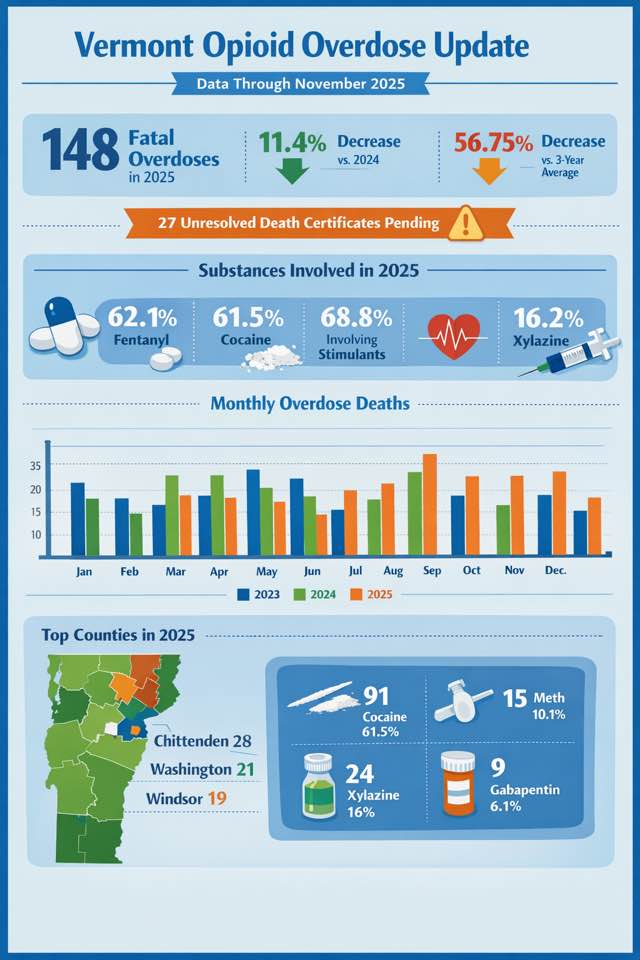
A Vermont opioid overdose infographic is making the rounds on social media. You’ve probably seen it. Clean graphics, bold numbers, downward arrows. It reports 148 fatal overdoses through November 2025, an 11.4% decrease from 2024, a 56.75% decrease from the three-year average. It breaks down the substances. It ranks the counties.
The numbers are real. And every number that drops represents a life saved, a family kept whole, a neighbor still with us.
But as a community justice ministry directly engaged with beloved neighbors who suffer from substance use disorders, Green Mountain Justice is compelled to speak out. We walk the streets and country roads of Vermont alongside our most marginalized neighbors. We sit with them in shelters and in the cold outside shelters. We know their names. We know what the infographic doesn’t show.
Substance use is a symptom, not a cause. It is the visible expression of profoundly broken systems of care and profoundly broken relationships between communities. And an infographic, no matter how well designed, cannot tell that story.
So let’s look behind the numbers.
A Decline in Context
The 56.75% drop from the three-year average sounds dramatic. It is dramatic. But the three-year average includes 2022, when Vermont hit a record 269 fatal overdoses. That pandemic-era spike distorts the baseline.
Here’s the fuller trajectory:
- 2019: 115 deaths (pre-pandemic baseline)
- 2020: 158 deaths
- 2021: 210 deaths
- 2022: 269 deaths (record peak)
- 2023: 236 deaths
- 2024: 183 deaths (22% decrease)
- 2025: 148 deaths through November (27 unresolved death certificates pending)
The trend is moving in the right direction. But even at 148, Vermont is still roughly 29% above pre-pandemic levels. We are not returning to normal. We are retreating from catastrophe. Those are different things.
Vermont last saw a significant decrease in 2019, when deaths dropped from 131 to 115. Then the pandemic hit. Isolation, unemployment, and fraying social connections sent the numbers spiraling. The current decline aligns with national trends. The CDC reported a nearly 27% drop in overdose deaths nationwide. Harm reduction efforts are working. Vermont distributed over 70,000 doses of naloxone to community partners in 2024 alone.
But we are still losing neighbors at a rate that would have been considered a full-blown crisis just six years ago.
The Per Capita Truth
The infographic lists the top three counties for fatal overdoses in 2025: Chittenden (28), Washington (21), and Windsor (19). At first glance, Chittenden looks like the epicenter. It’s not.
When you adjust for population, the picture flips:
- Chittenden County: 28 deaths / ~171,600 residents = 16.3 per 100,000
- Washington County: 21 deaths / ~59,800 residents = 35.1 per 100,000
- Windsor County: 19 deaths / ~57,700 residents = 32.9 per 100,000
- Vermont statewide: 148 deaths / ~647,000 residents = 22.9 per 100,000
Washington County’s rate is more than double Chittenden’s. Windsor is close behind. Both far exceed the statewide average.
Resources, media attention, and policy conversations tend to follow raw numbers. They flow toward Burlington. Meanwhile, smaller counties absorb a disproportionate toll with fewer treatment options, fewer recovery beds, and less infrastructure.
The UVM Vermont Legislative Research Service confirms this structural gap. Rural communities often lack community health centers. Some lack pharmacies entirely. Vermont’s hub-and-spoke treatment model is strong in concept. But when your nearest provider is 45 minutes away and you don’t have reliable transportation, the system fails you before you ever reach it.
The National Picture: Rural America Under Siege
Vermont is not an outlier. Across the country, rural communities face what researchers call the “rural penalty.” Despite national overdose deaths dropping roughly 21% by August 2025, rural areas continue to absorb a disproportionate toll. Nearly 22.4% of people in non-metropolitan counties used illegal drugs. Methamphetamine use among rural residents runs at more than double the rate of large metros. And new contaminants like metatomidine are being mixed with fentanyl, causing severe cardiac events that naloxone cannot reverse.
The structural barriers compound everything. Hospital closures. Acute shortages of mental health professionals. Isolation, poverty, stigma. In rural areas, many overdoses happen in private homes, placing the burden of emergency response on families who may not have naloxone on hand.
This reporting comes out of Maryland, where state and county health departments have far more investigative infrastructure than Vermont’s. Maryland tracks overdose data in near real-time, links it to toxicology and social determinants, and funds county-level rapid response teams. Vermont has neither the budget nor the staffing for that kind of granular surveillance. But we can learn from it. The patterns Maryland documents at scale are the same patterns GMJ sees on the ground in Addison, Washington, and Windsor counties.
This is exactly what Vermont’s per capita data reveals at the state level. Washington and Windsor counties are rural Vermont’s version of the national pattern: fewer resources, higher per capita rates, and communities carrying the crisis with less infrastructure to absorb it.
This Is Not an Opioid Crisis. It Is a Polysubstance Syndemic.
The 2025 data makes something undeniable. We need to stop calling this an opioid crisis.
The VLRS report defines a syndemic as synergistically interacting epidemics. That’s what Vermont is experiencing. Multiple substances, multiple overlapping vulnerabilities, and a drug supply that has become unpredictable and deadly in ways that outpace our response systems.
Look at the 2025 substance profile: fentanyl was involved in 62.1% of fatal overdoses. Cocaine appeared in 61.5%. Stimulants overall were present in 68.8% of deaths. These percentages overlap heavily. People are dying with multiple substances in their systems.
The 2024 data from the Vermont Department of Health is even starker. That year, 95% of fatal overdoses involved two or more substances. Fentanyl was present in 93% of opioid-related deaths. Cocaine involvement jumped to 70%, up from 60% in 2023.
The drug combinations have shifted dramatically over time. In 2010, the most common fatal combination in Vermont was prescription opioids and benzodiazepines. By 2021, it was fentanyl and cocaine, followed by fentanyl and xylazine. The landscape has been transformed.
Someone buying cocaine may not know it contains fentanyl. Someone using stimulants may not know xylazine is in the mix. The old categories no longer describe reality. And our response needs to catch up.
A Question About Xylazine
Speaking of xylazine: the 2025 infographic reports xylazine involvement at 16.2% of fatal overdoses. But the 2024 VDH data showed xylazine present in 42% of deaths, up from 32% in 2023. That’s a significant gap. Is this a methodological difference in how the data is captured? A real decline? A reporting lag? We don’t know yet, but it’s a question worth asking, because xylazine complicates everything about our response.
Xylazine is a veterinary sedative, not approved for human use. It causes dangerously low blood pressure, amnesia, and severe necrotic skin ulcerations. Most critically, naloxone does not reverse its effects. Every dose of naloxone we distribute is essential. But naloxone alone cannot address what xylazine is doing to our neighbors and our communities.
Intersectional Marginalization, Not Just Race
It would be easy to frame this crisis through a racial lens alone. Vermont’s BIPOC communities face devastating disparities. Black Vermonters are five to six times more likely to be unhoused than white residents. Vermont has one of the lowest Black homeownership rates in the country. At Green Mountain Justice, we document these realities daily.
But the overdose mortality data tells a more nuanced story. The VLRS report found that per capita overdose rates across racial demographics are nearly identical: 17.9 per 100,000 for white, non-Hispanic Vermonters and 16.1 per 100,000 for racial and ethnic minority groups. Ninety-four percent of overdose deaths occurred among white Vermonters, roughly proportional to the state’s demographics.
This doesn’t mean race is irrelevant. It means the primary vectors are class, poverty, housing insecurity, rural isolation, and generational impoverishment. These are the forces that push people toward substance use and away from treatment. Race compounds these forces. A Black Vermonter who is unhoused faces overlapping marginalization that a white Vermonter in the same shelter does not.
At GMJ, we call this intersectional marginalization. The overdose crisis finds people at the intersections where poverty meets mental health challenges, where disability meets rural isolation, where housing insecurity meets an unpredictable drug supply. Our neighbors who are most marginalized across multiple dimensions are the ones most at risk.
And the deadliest dimension of marginalization is isolation. Social autopsy data from 2022 and 2023 found that 35% of Vermonters who died from overdose were alone. No bystander present to intervene. Naloxone saves lives, but only when someone is there to administer it.
Connection saves lives. Relationship saves lives.
Why This Is Personal
Accurately assessing this intersectional vector is very close to our hearts at GMJ. A large percentage of beloved neighbors in our Neighbor Care ecosystem have suffered from substance addiction. Some of us have fostered children whose biological parents struggled with the pain that both causes and is substance use.
That might make us a little different.
We do think it’s critical to rigorously and completely analyze the data so we can fix our broken systems. But it’s essential that we not intellectualize the marginalization of our neighbors in need. Behind each of these numbers is a son, a daughter, a sibling, a friend, an equally and inherently valuable part of our community of communities.
Data can tell us where the systems are failing. It cannot tell us what it feels like to watch a neighbor you love disappear into addiction. It cannot capture the weight a foster parent carries when they learn the full story of why a child needed a new home. It cannot measure the courage it takes for someone in recovery to trust again.
We analyze the numbers because our neighbors deserve better systems. But we show up because our neighbors deserve love.
The Deeper Question: What Kind of Response Do Our Neighbors Deserve?
Here is where Green Mountain Justice parts company with much of the conventional response.
Infographics like this one are useful. The data matters. But we should be honest about what they often represent. Too often, overdose data circulates on social media as an argument for managed consumption, for clinical containment, for building spaces where people can use substances more safely while the rest of us maintain our distance.
We have to ask the harder question: will herding more of our neighbors who are suffering from unhealthful addictions into managed spaces actually create healthy relationships? Will it heal the disconnection that drove them to substance use in the first place? Or does it simply make the crisis more tolerable for those of us with the privilege of not living it?
At GMJ, we believe the overdose crisis is a relational crisis. The systems that are supposed to care for our most vulnerable neighbors have become transactional. They manage people. They process people. They keep people at arm’s length. And when those systems fail, which they do every day, our neighbors are left isolated, invisible, and at risk.
The conventional response asks: how do we make substance use safer?
GMJ asks a different question: how do we build the kind of community where our neighbors don’t need to numb themselves to survive?
These questions are not in opposition. Harm reduction saves lives. Naloxone saves lives. Fentanyl test strips save lives. We carry naloxone. We support every tool that keeps a neighbor alive for one more day. One more day is one more chance for connection.
But harm reduction without relational transformation is management, not healing. It outsources our moral responsibility. It allows communities of privilege to fund a program, file a report, and go home feeling like the problem is being handled. It keeps suffering at a comfortable distance.
What our neighbors need is not more programs. They need us. They need neighbors of privilege to show up, build trust, and stay. Not to fix them. Not to manage them. To love them. To ask not “are you like us?” but “what’s it like to be you?”
What GMJ Is Doing About It
Green Mountain Justice exists in the intersections where these crises converge. We don’t run a clinic. We don’t operate a safe-use site. We minister with neighbors seeking deeper connections. Neighbors growing to understand that love-centric, trusting relationships will make all the difference.
We show up. On the streets, on the country roads, in the shelters, and in the gaps between services. We practice relational care, not transactional services. We build the Neighbor Care Network one relationship at a time.
And we’ll keep showing up. As long as one beloved neighbor, one family, one community is suffering from this, Green Mountain Justice will be there. Not because the data tells us to. Because our neighbors are worthy of care, connection, and dignity.
The numbers are moving in the right direction. That matters. But numbers don’t save lives. People do. Relationships do. Proximity does.
The question before all of us is not whether the overdose numbers will keep declining. The question is whether we are willing to close the distance between ourselves and our neighbors who are suffering. Whether we will keep outsourcing care to systems that manage people, or whether we will do the harder, more transformative work of building community across lines of difference.
At Green Mountain Justice, we already know the answer.
Care. Connect. Collaborate.
If you or someone you know is struggling with substance use, contact Vermont Helplink at 802-565-5465 or text “LINK.” Free naloxone is available at distribution sites listed at HealthVermont.gov. Vermont’s Good Samaritan Law protects you when you administer naloxone in good faith.
Tom Morgan is the founder of Green Mountain Justice, a community justice ministry serving Vermont’s most marginalized neighbors. Listen to our podcast, Voices from the Edge, wherever you get your podcasts.
Sources:
- Vermont Department of Health, “Opioid Overdose Dashboard,” HealthVermont.gov
- Vermont Department of Health, “2024 Fatal Opioid Overdoses Among Vermonters”
- Vermont Department of Health, “Deaths from Opioid Overdose Declined Significantly in 2024”
- Vermont Legislative Research Service (UVM), “The State of the Opioid Crisis in Vermont Today,” December 2023
- 2025 Report to the Legislature: Overdose Prevention Center Evaluation

